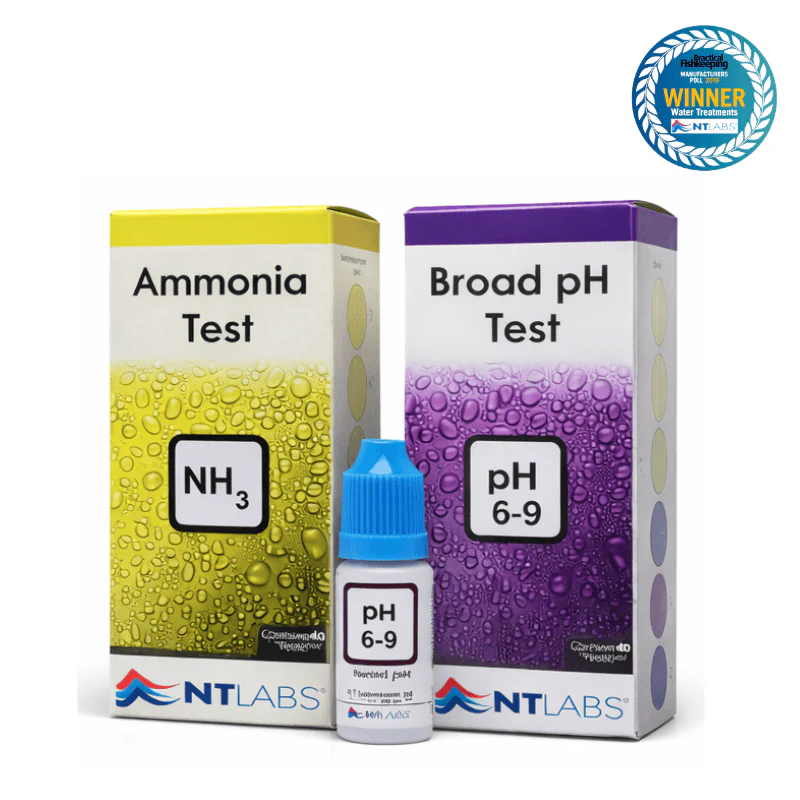
NT Labs Water Test Kit - Ammonia/pH 6-9 Test
NT LABS Test Ammonia
What is ammonia?
Ammonia is the main waste product produced by fish as a result of feeding. It can also be generated by the decay of uneaten food or decaying organic matter, such as plant leaves. It is invisible to the naked eye and its presence or absence cannot be determined by looking at the water alone. It is extremely toxic to the fish but is broken down into less toxic nitrite by the beneficial bacteria found in the filter.
What is the correct ammonia level?
There is no occasion where any ammonia is tolerable. A level of zero mg/l (ppm) should be maintained at all times.
What do I do if the ammonia level is wrong?
If a level of 0.2 mg/l (ppm) is found, add a filter booster such as Filter Starter. If a level above this is found, then a substantial water change is essential. Change 25% of the volume for 0.5 – 1.0 mg/l (ppm) ammonia and 50% for ammonia levels above this. Add Ammonia Remover to the filter compartment to remove ammonia. If any amount of ammonia is found, then it is important to check other vital water quality parameters, in particular pH, KH and nitrite.
How to use?
- Ensure the test tube is clean.
- Take a 5 ml sample of water into the test tube.
- Add 5 drops of the reagent Ammonia 1, 5 drops of Ammonia 2 and 5 drops of Ammonia 3.
- Replace the test tube cap and shake thoroughly. Wait 10 minutes, then compare the colour of the sample to the colour scale provided. Zero ammonia is represented by a yellow colour. Any hint of green in the sample indicates the presence of ammonia in the water.
This test kit reports concentration in terms of nitrogen (NH3-N) to be compatible with reported safe concentrations as they apply to fish and plants. If you are interested in knowing the ionic concentration of the measured parameter, multiply your result by 1.21 (NH3-N).
FAQs:
Q: Why do I run out of 1 reagent before the other(s)?
A: We fill our test kit reagent bottles to a minimum amount before they are put through a vigorous QC regime. This means that the vast majority of bottles will in fact be overfilled by varying amounts meaning that the reagents may well run out at different rates but you should be able to carry out at least the number of tests stated on the packaging.
Q: My Ammonia 2 reagent has turned blue, is it still okay to use?
A: Our Ammonia 2 reagent can take on a blue colour with time, but it does not affect he performance or results of the test. As long as the test kit is still within date, you can be confident in the reliability of the results it produces.
NT LABS Test pH 6-9
What is pH?
The new Broad Range pH Test is for testing water within the pH range of 6 – 9. This pH test now covers the pH range more likely observed in your aquarium and also offers improved precision with 0.5 unit determination.
What is the correct pH level?
There is no definitive correct pH as different fish species have their preferred pH range. Generally, the ideal pH value will lie between 7 and 8, but there are some exceptions. When purchasing fish from your local aquatic retailer, always enquire as to the specific water requirements of the fish you are buying.
What do I do if the level is wrong?
If you do need to adjust the pH of your aquarium, it is vital to do this slowly to not shock the fish. Change no more than 0.5 pH units per 2 days. Providing your tap water is of suitable pH, substantial water changes can correct a dangerous pH level. It is also important to check the KH of the aquarium. Use of pH adjusters, such as KH Up – pH Stabiliser will raise the pH caused by soft or aged water. For fish that live in soft, acid water use bogwood to gently lower the pH and soften the water.
How to use?
- Ensure the test tube is clean.
- Take a 5ml sample of water into the test tube.
- Add 5 drops of the pH reagent; replace the test tube cap and shake thoroughly.
- Compare the colour of your sample to the colour scale provided.
FAQ:
Q: My pH reagent has changed colour, is it still ok to use?
A: Our pH reagent can change colour over time. It will start green, but can change to any colour on the colour chart. This is normal and you will still get accurate results.
Original: $8.64
-65%$8.64
$3.02Product Information
Product Information
Shipping & Returns
Shipping & Returns
Description
NT LABS Test Ammonia
What is ammonia?
Ammonia is the main waste product produced by fish as a result of feeding. It can also be generated by the decay of uneaten food or decaying organic matter, such as plant leaves. It is invisible to the naked eye and its presence or absence cannot be determined by looking at the water alone. It is extremely toxic to the fish but is broken down into less toxic nitrite by the beneficial bacteria found in the filter.
What is the correct ammonia level?
There is no occasion where any ammonia is tolerable. A level of zero mg/l (ppm) should be maintained at all times.
What do I do if the ammonia level is wrong?
If a level of 0.2 mg/l (ppm) is found, add a filter booster such as Filter Starter. If a level above this is found, then a substantial water change is essential. Change 25% of the volume for 0.5 – 1.0 mg/l (ppm) ammonia and 50% for ammonia levels above this. Add Ammonia Remover to the filter compartment to remove ammonia. If any amount of ammonia is found, then it is important to check other vital water quality parameters, in particular pH, KH and nitrite.
How to use?
- Ensure the test tube is clean.
- Take a 5 ml sample of water into the test tube.
- Add 5 drops of the reagent Ammonia 1, 5 drops of Ammonia 2 and 5 drops of Ammonia 3.
- Replace the test tube cap and shake thoroughly. Wait 10 minutes, then compare the colour of the sample to the colour scale provided. Zero ammonia is represented by a yellow colour. Any hint of green in the sample indicates the presence of ammonia in the water.
This test kit reports concentration in terms of nitrogen (NH3-N) to be compatible with reported safe concentrations as they apply to fish and plants. If you are interested in knowing the ionic concentration of the measured parameter, multiply your result by 1.21 (NH3-N).
FAQs:
Q: Why do I run out of 1 reagent before the other(s)?
A: We fill our test kit reagent bottles to a minimum amount before they are put through a vigorous QC regime. This means that the vast majority of bottles will in fact be overfilled by varying amounts meaning that the reagents may well run out at different rates but you should be able to carry out at least the number of tests stated on the packaging.
Q: My Ammonia 2 reagent has turned blue, is it still okay to use?
A: Our Ammonia 2 reagent can take on a blue colour with time, but it does not affect he performance or results of the test. As long as the test kit is still within date, you can be confident in the reliability of the results it produces.
NT LABS Test pH 6-9
What is pH?
The new Broad Range pH Test is for testing water within the pH range of 6 – 9. This pH test now covers the pH range more likely observed in your aquarium and also offers improved precision with 0.5 unit determination.
What is the correct pH level?
There is no definitive correct pH as different fish species have their preferred pH range. Generally, the ideal pH value will lie between 7 and 8, but there are some exceptions. When purchasing fish from your local aquatic retailer, always enquire as to the specific water requirements of the fish you are buying.
What do I do if the level is wrong?
If you do need to adjust the pH of your aquarium, it is vital to do this slowly to not shock the fish. Change no more than 0.5 pH units per 2 days. Providing your tap water is of suitable pH, substantial water changes can correct a dangerous pH level. It is also important to check the KH of the aquarium. Use of pH adjusters, such as KH Up – pH Stabiliser will raise the pH caused by soft or aged water. For fish that live in soft, acid water use bogwood to gently lower the pH and soften the water.
How to use?
- Ensure the test tube is clean.
- Take a 5ml sample of water into the test tube.
- Add 5 drops of the pH reagent; replace the test tube cap and shake thoroughly.
- Compare the colour of your sample to the colour scale provided.
FAQ:
Q: My pH reagent has changed colour, is it still ok to use?
A: Our pH reagent can change colour over time. It will start green, but can change to any colour on the colour chart. This is normal and you will still get accurate results.